
April 2026
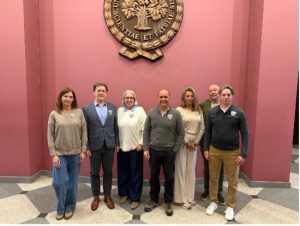
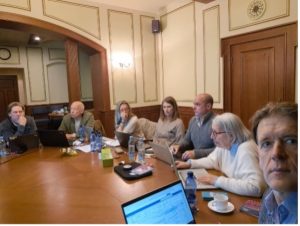
An in-person meeting of the EAS Executive Board took place in Riga on April, 23, 2026.
During the session, President Laura Capranica presented the 2025 activity report, outlining the main achievements and initiatives carried out over the past year. Secretary Ole Keldorf presented the EAS amended Statute, in accordance with applicable legislation. At the same meeting, Treasurer Mojca Doupona delivered the 2025 financial report, providing an overview of the organization’s financial management and stability. All these documents were carefully reviewed by the Board members and were unanimously approved, reflecting strong agreement on the work accomplished.
The Board also discussed the contribution of EAS to the development of ongoing Erasmus+ Sport Collaborative Partnerships, emphasizing their role and impact. In addition, the possibility of participating in the current call for proposals under the program was considered.
Proposals for upcoming EAS Cafés were presented and discussed, with the next event scheduled on May 18th.
Reports from the committees were also presented by Antonio Figueiredo (Scientific Committee), Ole Keldorf (NewGen Committee), and Laura Capranica (Communication Committee), highlighting the work carried out in their respective areas.
A preliminary draft of the program for the upcoming EAS Conference to be held in Oulu on October 5-7, 2026 was introduced by Risto Keskitalo, with further input provided by the Board members.
Finally, regarding the upcoming elections for the presidency and the Executive Board, it was agreed that the call for candidates will be open in second half of May.
The Members of the Executive Board were thankful to Ilvis Abelkalns (member of the EAS Board) for organizing and hosting the meeting at the University of Latvia.
On April 15 and 16, 2026, EAS was invited to attend the annual EU Sport Forum “Values, Inclusion, and Wellbeing” organized by the European Commission in cooperation with the Cyprus Ministry of Education, Sport and Youth in Phapos, Cyprus.
Mr. Normunds Popens ‐ Deputy Director-General of the Directorate-General Education, Youth, Sport and Culture (EAC) of the European Commission, and Mr. Marios Panayides ‐ Permanent Secretary, Ministry of Education, Sport and Youth of Cyprus, welcomed delegated of leading sport organisations, sport federations, European networks, and policymakers to the two-day event encompassing keynote speeches, plenary and parallel sessions, and panel discussions on relevant issues of the European Sport Model.
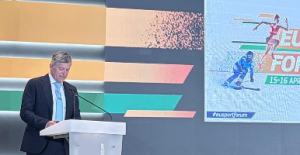
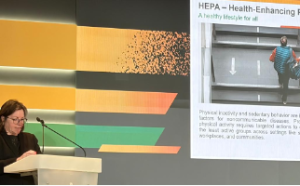 Mrs. Paola Ottomano, Team Leader, Sport Unit of the European Commission, and Mr. Luciano Di Fonzo, Deputy Head of Erasmus Mundus and Sport Unit of the European Education and Culture Executive Agency (EACEA), informed on the strategic vision for sport in Europe, including the results of the public consultation on the European Sport Model.
The thematic discussion of the first day of the event regarded: Removing barriers to women’s sporting success; Rewarding talent in sport: boosting solidarity and competitive balance; Not just medals, rethinking sport for lifelong wellbeing; The future of the European Week of Sport; The future priorities of the Irish Presidency of the Council; Uniting the Mediterranean through sport; Mental health in sport: pressure and resilience; Knowledge sharing sessions on good practices from Cyprus; Peer learning activities in Bulgaria and Slovenia; and The project GAIIN from the World Anti-Doping Agency.
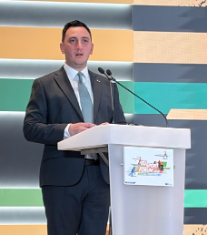
On the second day, Mr. Glenn Micallef, European Commissioner for Intergenerational Fairness, Youth, Culture and Sport, presented his personal contribution to key priorities and activities of the European Commission in the field of sport, highlighting the crucial role of physical literacy for lifelong active behaviours and health. This issue was further emphasized during the round table Move more, live better: why movement matters at every age with high-level speakers and contributors. The last two sessions were dedicated to the athletes’ experiences into sport governance roles, and the integrity and investment for the future of European basketball. Final remarks were provided by Mr. Georg Häusler, Director of Culture, Creativity and Sport of the European Commission. Further information and Recordings of the 2026 EU Sport Forum will be available at sport.ec.europa.eu.
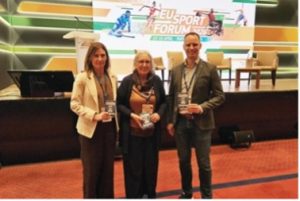
During the event, EAS and EUSA also disseminated information on the ERASMUS+Sport Collaborative Partnership “Discovering University Sport and Supporting Dual Career” (DiscoverU), which aims to encourage innovative community engagement in physical activity and healthy lifestyles among university students.

The DiscoverU project is funded by the European Union coordinated by EUSA. Views and opinions expressed are however those of the author(s) only and do not necessarily reflect those of the European Union or the European Education and Culture Executive Agency (EACEA). Neither the European Union nor EACEA can be held responsible for them.
On March 18, 2025, the European Parliament’s Committee on Culture and Education (CULT) invited European sports stakeholders at the European Parliament to contribute to a consultative meeting on the role of the EU policies in shaping the European Sport Model.
Member of the European Parliament Bogdan Zdrojewski, Vice-Chair of the CULT Committee and rapporteur of the initiative, welcomed the participants, followed by presentation by Iwona Lotysz (Polish Presidency of the Council of the European Union) Giorgio Guazzugli-Marini (Acting Head of Sport Unit at the European Commission), and Roberto Pella, (European Committee of the Regions, rapporteur of the opinion on “Building a values-based, bottom-up European sports model: a vehicle for encouraging inclusion and social wellbeing among young Europeans).
Overall, 40 stakeholders participated in the event, with 20 of them providing short speeches in contribution to the European sports policies. Laura Capranica, EAS President, highlighted the importance of European ERASMUS+Sport fundings for cooperative partnerships focused on the sportspersons’ rights to education in and through sports. She highlighted that whilst Europe has been considered a good model and inspiration for countries beyond Europe (recently, a dual career association has been established in Brazil following the EAS example), the tremendous outcomes of the ERASMUS+Sport projects do not always reach the target population at large. To bridge such a gap and to have a positive impact especially in the future generations of athletes, coaches, physical trainers, referees, sports managers, sports scholars, and volunteers, President Capranica suggested the adoption of European policies urging the sport academic institutions and the sport bodies to include relevant European priorities (such as dual career, sport inclusion, sport integrity, safeguarding, etc) in their educational courses.
REG. NUMBER: Voluntary Organisation registration VO/1270
PIC NUMBER: 913459865
Email: info@dualcareer.eu