
Our Blog
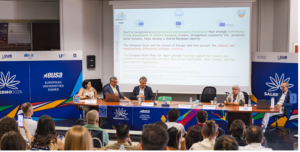 On July 20, 2026, the University of Salerno (Unisa) hosted a panel on Student-Athletes and Dual Career, within the framework of the European University Games 2026. After offering a concise overview of European approaches to dual career, personalized academic pathways, and the psychological and institutional conditions that support student-athletes, Prof. Francesca D’Elia (Unisa) moderated the panel of leading experts in sport policy, higher education, and wellbeing.
Laura Capranica (EAS President) highlighted the European policy framework connecting sport, education, and health. She emphasized cooperation among institutions, cultural diversity across Member States, and the need for structured dialogue between sport and education stakeholders. Speciafically for the University context, she highlighted the relevance of the European cooperation projects Give Sport a Say under the Citizens, Equality, Rights and Values (CERV), and the Collaborative Partnerships DiscoverU, Edmedia, Find Me, More Than Gold, and Runners4All under the ERASMUS+Sport.
Andreas Csonka (EUSA EUSA Executive Committee Member) framed dual career as a wellbeing, education, and talent policy, stressing predictable flexibility, full academic choice, and institutional reliability. He underlined the role of EUSA in enforcing the European principles: flexibility in models, consistency in outcomes, and no forced dropout.
Gaetano Raiola (Pegaso University) presented the transition from the school Personalized Learning Pathway (PFP) to university dual career programs. He illustrated regulatory tools, flexible exam scheduling, tutoring schemes, and the recognition of certified sporting activities through Italian Ministerial Decree 931/2024, enabling coherent and personalized academic pathways.
Ruggero Andrisano Ruggieri (Unisa) explored the psychological dimension of dual career through the “Double Family” construct, describing relational tensions between family, sport, and university. He proposed the university as a third space supporting autonomy, coordination, and wellbeing through mapping, clarification, direct communication, and monitoring.
Antonella Apicella, Captain of Salernitana Women Soccer Team, presented the challenges and opportunities of a university student-athlete, offering further for the implementation of dual career support policies and provisions.
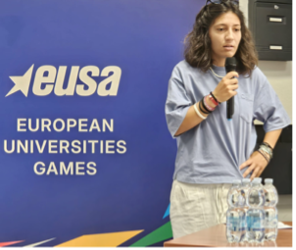
The discussion reinforced a shared message: dual career requires coordinated systems, personalized pathways, and attention to wellbeing. The University of Salerno expressed its commitment to advancing dual career initiatives and exploring a dedicated institutional regulation aligned with European recommendations and the mission of EAS and EUSA.

The DiscoverU, EdMedia, Find Me, Give Sport a Say, More Than Gold, and Runners4All projects are funded by the European Union. Views and opinions expressed are however those of the author(s) only and do not necessarily reflect those of the European Union or the European Education and Culture Executive Agency (EACEA). Neither the European Union nor EACEA can be held responsible for them.
REG. NUMBER: Voluntary Organisation registration VO/1270
PIC NUMBER: 913459865
Email: info@dualcareer.eu