
EAS Cafe
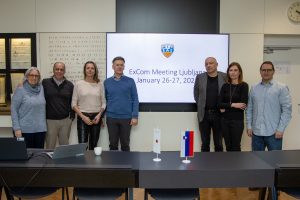
On January 26-27, 2024, the University of Ljubljana (Slovenia) hosted the EAS Executive Board. During a two-day meeting, Ole Keldorf, Antonio Figueiredo, and Laura Capranica proposed activity plans of New Generation Committee (Next GEN EAS), the Scientific Committee, and the Communication Committee, respectively.

Updates on the participation of EAS in the ERASMUS+ Capacity Building Sports as Value (101093451 to build the capacity of sport managers and coaches in Balkan region to promote values in and through sport) and in the Collaborative Partnerships (COMPATH, 101050955 – Promoting Employability of Young Student-Athletes through ‘‘Competence Hub on Sport Innovation’’; Talent, 101090147 – Cloud-based education for creative sport talents; DC MENTOR, 101132309 – Enhancing Athlete Employability through Career Mentorship and Education; DiscoverU, 101134052 – Sport and physical activity opportunities for students in higher education; SMART START for DC, 101133555 – To encourage the dual career of young high school athletes aged 14 and 19; FIND ME, 101134043 – to structure an evidence-based European platform specifically tailored for dual career at university level) were shared.

The Board approved unanimously the 2024 activity and financial reports and envisaged the organization of three online cafès (March, June, and November 2024), the first one dedicated to “Students-Athletes facing the Olympic Games Students. Furthermore, the visit of the EAS ExCom Members Ole Keldorf and Risto Keskitalo to the Academy of Physical Education Katowice (Poland) was planned to prepare the 2024 Annual Conference.
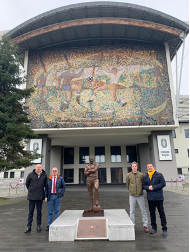
On February 27, 2024, the Academy of Physical Education Katowice (Poland) Vice Rector Rajmund Tomik and the Director of international Relations Piotr Rodak welcomed Ole Keldorf and Risto Keskitalo and showed the venue of the 2024 EAS Annual Conference to be held on October 1-3, 2024. The co-operation between EAS and the host was sealed with Rector Grzegorz Juras.
During the well-prepared meeting, the Conference programme and the practical arrangements have been defined to provide the best opportunities for a EAS members to have a great time in Katowice.
The celebration of the 20th anniversary of the EAS Conference in Katowice, the European City of Science in 2024, is a special opportunity to highlight the contribution of dual career of sportspersons to the advancement of a European culture in and through sports on all aspects of life. In fact, the Conference is dedicated to “Dual career at school and university – innovative bridges between sport and education”
Further information of the 2024 Conference is available at https://eas24.awf.katowice.pl
Coordinated by the University of Limerick (IRE) in cooperation with EAS (MLT), Elite Sports Academy Aarhus – ESAA (DEN), European University Sports Association Institute – EUSA (SLO), European Platform for Sports and Innovation – EPSI (BEL), Human Age Institute Foundation (ITA), Roma Tre University (ITA), University of Ljubljana (SLO), and University of Nis (SRB), after three years the Brand Values Alignment through Dual Career (BRAVA) project, co-funded by the European ERASMUS+Sport Programme (622824-EPP-1-2020-1-IE-SPO-SCP), has come to its end. On December 12, 2023, EPSI hosted the last transnational meeting of BRAVA-DC in Brussels (BEL) to discuss the achieved outcomes and to foresee further development in the dual career of the employee-sportsperson. Despite the pandemic challenges, the consortium successfully accomplished important steps in uncovering the evidence and eminence of the dual career at the workplace, which were summarized in scientific contributions, and a report with 16 guidelines and an evaluation tool available at https://edu.bravadualcareer.eu.
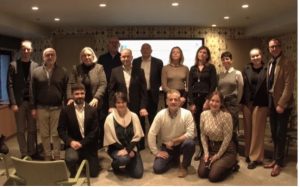
In the afternoon, more than 30 in-person and 100 online participants attended the Final Conference of BRAVA-DC, which was organized in conjunction with the 11th EAS online Cafè. Alberto Bichi (Director of EPSI) welcomed the participants on behalf of the hosting organization and project consortium, and Prof Ciaran Mac Donncha (Coordinator, University of Limerick) illustrated the main outcomes and findings of the project.

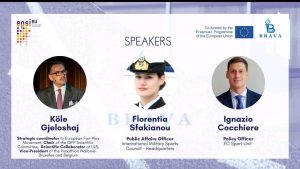
Dr. Kolë Gjeloshaj (Strategic coordinator at the European Fair-Play Movement – EFPM), previous Chair of the International Fair-Play Committee – CIFP) Scientific Committee, Scientific Collaborator at the Institute of Sociology of the Université Libre de Bruxelles and Vice-President of the Panathlon Wallonie-Bruxelles and Belgium) emphasized the relevance of values for dual career, which need more reflections and future actions.

Navy Officer Florentia Sfakianou (Olympian and Public Affairs Officer at International Military Sports Council – CISM), presented the dual career opportunities offered by military sports to actual and former athletes and the efforts of CISM in organizing one of the largest global sports events.

Dr. Ignazio Cocchiere (Policy officer in the Sport Unit of the European Commission’s department for Education, Culture, Youth and Sport – DG EAC, and soccer player) highlighted the European values and priorities in the field of sport, including the importance of dual career from the viewpoint of the EU and Sport Unit. He also offered his personal dual career experience as a professional football player in Italy, Switzerland and Belgium, and as an employee at the EU institutions.
More information on BRAVA-DC project is available at www.bravadualcareer.eu.
December 12, 2023 (from 13:55 CET)
13:30-13:55 Online connections
13:55 Welcoming of participants/speakers
Alberto Bichi (Director EPSI)
Prof. Ciaran Mac Donncha, University of Limerick (IRE) Coordinator of the BRAVA DC Collaborative Partnership
On June 1st, 2023, more than 80 participants, including university students from Niš (Serbia) attended online the tenth EAS Cafè “Dual career as European sports diplomacy”, moderated by Prof. Antonio Sanchez-Pato, Director of the Sports Science Area at the Universidad Internacional de La Rioja (UNIR, Spain) and member of the EAS Executive Committee.

Prof. Sanchez-Pato introduced the theme of the Cafè by offering the definitions of sport diplomacy and examples of this powerful tool to improve the dialogue, relations, and cultural exchanges between communities, to defuse tensions and to build bridges between countries. He also highlighted the role of education of sportspersons whose experiences of a globalized sport environment could help them developing skills useful in the diplomatic arena. Finally, he emphasized the potential of e-learning to support dual career worldwide, especially in considering that some European universities historically have a relevant cultural exchange in other continents, such as Latin America.


The first speaker, Prof. Felipe Rodrigues Da Costa, Assistant Professor at the Physical Education Faculty of the Brasilia University (FEF/UnB) and Coordinator of the Post-graduate Program in Physical Education, summarized the development of dual career in Latin America, starting from his post-doc experience at the University of Coimbra and his cooperation with Prof. Antonio Figueiredo, Member of the EAS Excecutive Committee. He illustrated not only his personal dedication to the development of dual career research in Latin America that resulted in a tremendous increase of scientific contributions during the past few years, but also the capitalization of the good practice of EAS for establishing a dual career Ibero-American network, which resulted in the organization of international seminars and the participation of Brazilian delegates to the EAS conference.
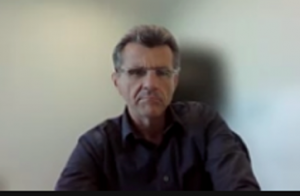
The second speaker, Prof. Karim Chamari, Head of Aspetar Injury and Illness Prevention Program (ASPREV) at Aspetar, Doha (Qatar) presented his difficulties in combining his academic and sport careers as a Tunisian Olympic windsurfer at the Barcelona Games in 1992. Whilst in Tunisia he struggled to have dual career arrangements at academic level, as a PhD student at the University of Montpellier (France) he engaged in personal negotiations with his PhD tutor to have a 4-month break from his research studies to prepare for the Olympic Games. Suffering a sudden end of his sport career due to an unexpected severe pathology, Prof. Chamari benefited from his bio-medical studies to recover his condition. Despite a lack of institutional dual career support, Prof. Chamari’s determination made him a well-prepared coach of professional soccer players and one of the most rewarded outstanding scholars.

In summarizing the general discussion, Prof. Sanchez-Pato underlined the main role of dual career in establishing understanding between cultures, scientific research, and cooperation between organizations. He also urged young researcher to send their application to the Bengt Nybelius Scholarship before July 1, 2023, and anticipated that an EAS survey will be mailed to its internal and external stakeholders to collect their opinions regarding the past and future EAS activities. Before closing the Tenth EAS Cafè, the participants were informed that the next EAS Cafè will be organized in fall, after the Annual Conference to be held in Gaeta next October 2-4, 2023.
Tenth EAS Online Cafè
“Dual career as European sports diplomacy”
Zoom Meeting June 1, 2023 (from 12:00 CET)
12:00 Welcome words: Prof. Antonio Sanchez-Pato
Director of the Department of Sports Sciences. Faculty of Health Sciences, International University of La Rioja.
12:10 – Prof. Felipe Rodrigues Da Costa: “Dual Career in Brazil: research, actions, and the (possible) European Experience”.
Prof. Felipe Rodrigues Da Costa is Assistant Professor at the Physical Education Faculty of the Brasilia University (FEF/UnB) and Coordinator of the Post-graduate Program in Physical Education – PPGEF/UnB. He is the Coordinator of the Research Group on Sports Training and Athlete Career (DuCa), President of the Brazilian Association on Dual Career (ABDC), Member of the IberoAmerican Network on Dual Career, and develops research on dual careers at master’s and doctorate levels. Prof. Da Costa has been working with the theme of dual careers since 2010 when he started his Ph.D. at Gama Filho University in Rio de Janeiro (Brazil), and participated in the organization of the International Seminar on Dual Careers and other events. He completed a postdoctoral internship at the University of Coimbra, supervised by Professor Dr. Antonio Figueiredo.
12:30 – Prof. Karim Chamari: “Surfing: from the sea’ waves to online research papers’’
Prof. Karim Chamari is Head of Aspetar Injury and Illness Prevention Program (ASPREV) at Aspetar, Doha, Qatar. He is a former elite athlete who participated in the 1992 Barcelona Olympic Game in windsurfing. Doctor in Exercise Physiology and University Full Professor, Prof. Chamari is one of the most active Sport Science researchers. He has published 400+ publications in peer-review journals (H-index 66, Scopus) and more than 20 book chapters, particularly focused on football (soccer) science and medicine and Ramadan fasting. He has also an extensive field experience as fitness coach of professional Tunisian Footballers for more than 10 years. Prof. Chamari has been the leader of the Tunisian Research Laboratory ‘Sport Performance Optimization’ of the National Centre of Medicine and Science in Sport, Tunis, Tunisia for 10 years before joining Qatar in 2013.
12:50 – General discussions and concluding remarks
On February 27th the ninth virtual EAS cafè focused on the dual career from the educational and employment perspectives and the human rights of the sportsperson. The event attracted more than 100 participants, including university students from Niš (Serbia). Prof. Antonio Tessitore from the University of Rome Foro Italico moderated the event.

The first speaker, Dr Köle Gjeloshaj (Vice President of the Panathlon Wallonie Brussels, strategic coordinator for the Féderation Wallonie Brussels in the context of the Belgium EU Presidency 2024 in the department of the International Relations, and scientific collaborator of the Université libre de Bruxelles), highlighted the relevance and intriguing nature of the title of the event, particularly in relation to its novelty within the international sport environment.

He focused on the framework and approach of the IOC and other major international sports organizations in relation to the safeguard of human rights, the human resources management, and the dual career support for elite sportspersons (i.e., the IOC/Adecco Athlete365 Career+ programme). In particular, Dr. Gjeloshaj stressed the need to establish a legal framework that should guarantee the rights of elite athletes as workers and/or as students within different parallel and/or transition career trajectories and a lifelong learning perspective. Furthermore, in considering the relevant competencies and skills developed through and during an elite athletic career, the employment sector should further recognize the value of sportspersons as workers, which could also be a concrete action from the corporate social responsibility perspective.

The second speaker, Dr Giovanni Di Cola (Special Adviser at the International Labour Organization, ILO) presented current practices and recommendations in relation to the advancement of decent work in sport. Concrete examples have been presented (i.e., the IOC sustainability strategy; the UEFA sustainability strategy), which highlighted the need to adopt a comprehensive approach to guarantee appropriate and sustainable working policies and conditions in the sport sector. To meet the needs of a complex and rapid development of sport environment, Dr. Di Luca claimed that there is an urgent need for major sports organizations to take actions and accelerate the processes. Major recommendations included the focus on athletes’ working conditions and collective bargaining, the acceleration of sustainability in sport, the reinforcement of dual careers though competencies and skills recognition and development, and the review of traditional models adapting to evolving environments and conditions within the sport sector.
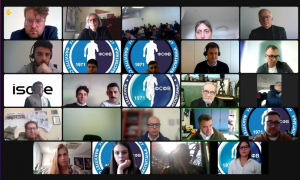
Following the general discussion addressing the main themes discussed during the Cafè, both speakers emphasized the urgent need of a cooperation between organizations for concrete and effective actions accelerating the policy development and implementation processes of the recognition of the rights of elite sportspersons as students and workers,
In closing the event, President Laura Capranica informed that the tenth EAS Cafè will be organized in April/May and that the University of Cassino and Lazio Meridionale will organize the 2023 EAS Conference in Gaeta (Italy). Finally, the President invited young researchers to apply to the Bengt Nybelius Scholarship.
“Dual Career from Education to Work: Human Right of the Sportsperson”
Zoom Meeting February 27, 2023 (from 12:00 CET)
12:00 Welcome
Prof. Antonio Tessitore, PhD – University of Rome Foro Italico, and Chair of the EAS Scientific Committee.
12:10 – Köle Gjeloshaj, PhD: “Dual career of athletes at the International sports organizations”
Vice-President of the Panathlon Wallonie-Bruxeles, Belgium and strategic coordinator of the president of the European Fair-Play Movement, Scientific Collaborator at the Université Libre de Bruxelles, dr. Gjeloshaj worked from 1996 to 2017 at the International University Sports Federation (FISU), for which he set up the educational and development departments as Director of the Educational department. He joined the International School Sport Federation (ISF) in 2018, where he covered the position of Deputy Secretary General until 2022. He is now a civil servant within the Federation Wallonie Bruxelles as coordinator of the logistical team for the Belgium Presidency of the EU in 2024 of the International Relations Department. Dr. Gjeloshaj was the team leader for FISU of the Proclamation by UNESCO (2015) of the International Day of University Sport. The Co-rapporteur (2021-22) of the High Level Group on Gender Equality in Sport of the European Commission. From 2020 to 2022, he chaired the Consultative Committee of the Enlarged Partial Agreement on Sport of the Council of Europe. He is an alumni of ULB (Political sciences) and the University of Pisa (Anti mafia and corruption).
12:35 – Giovanni Di Cola, PhD: “Rights and obligations and dual career of professional athletes”
Dr. Giovanni Di Cola has a wide experience within the United Nations System, having served in various UN agencies (UNESCO, UNFPA, UNICEF, and ILO) with assignments at the UN Staff College and the UN Secretariat, on matters related to the UN reform, Youth leadership and Sport for Development and Peace. He contributed to establish a network of 150 universities, on local economic development as ILO inter-regional programme (Universitas) coordinator between 2001 and 2008 based in Geneva. Since 2016, he was instrumental in establishing the multistakeholder initiative as Centre for Sport and Human Rights in 2021, to which he ensured that ILO could be represented as founding member and permanent observer. He was lead expert of the ILO Global Forum on Decent work in the world of sport of January 2020, in which the ILO Points of Consensus were adopted.
13:00 – General discussions and concluding Remarks
EAS Online Cafè was held online December 5, 2022
AGENDA
12:00 Welcome
Prof. Daniele Conte, PhD – University of Rome Foro Italico and Lithuanian Sports University.
12:10 Hakon Ege – ELCAMP Project: A Self-employment Career Option for Athletes: Sports Entrepreneurship Bootcamp
Håkon Ege performed Teakwondo professionally for 12 years. After his sporting career, he started to work as a researcher, lecturer and project manager in different organizations such as universities and non-governmental organizations. He is working on encouraging and empowering individuals and organisations to be more innovative and entrepreneurial in and through sport so that they can design, develop and initiate actions that address socio-economic and planetary needs. In 2018, he launched Collective Innovation, an impact-driven initiative to foster and drive innovation in Norway and Europe.
12:25 Sinan Güler – Giving Back to Sports and Innovation
Sinan Güler is a former national basketball player with a 16-year basketball career, winning the league championships and league cup championships, as well as the 2nd place in the World Cup with the National Team in 2010 and the EuroCup with Galatasaray in 2016. In 2011, he started a social initiative called Güler Legacy with his older brother Muratcan Güler, who is also a former basketball player, and his father Necati Güler. Since 2012, he has been doing important work in the field of startup ecosystem, as an angel investor and mentor. Since 2020 he has been interested in sports technologies & innovation.
12:40 Morten Munch Mindegaard – The ATLas project on Dual Career Entrepreneurship
Dual Career Adviser at the Enterprise and Innovation – Innovation and Entrepreneurship (The Kitchen)
of the University of Aarhus. Aarhus University and The Kitchen is part of the Erasmus+ course AtLAS, which is an entrepreneurial course tailor-made for elite athletes who have the opportunity to test themselves in an entrepreneurial context.
12:55 General discussions and concluding Remarks

On June 21 the seventh virtual EAS cafè focused on the dual career of paralympic athletes, which attracted more than 50 participants. Prof. Alejandro Leiva-Arcas, Deputy Director of the Faculty of Sport at UCAM moderated the event and presented the aims and progress of the ERASMUS+ project Dual Career of Student-Athletes with Disabilities as a Tool for Social Inclusion (Para-Limits, 622213-EPP-1-2020-1-ES-SPO-SCP) coordinated by the Catholic University of Murcia (UCAM), Spain, in cooperation with University Foro Italico of Rome (IT), UNEFS (RO), IPV (PT), University of Limerick (IE), COLLINN (NO), EAS Network (MT), the European Paralympic Committee (AT) and the FUNDACION ONCE (ES).
 As the first speaker, Lisa Gjessing presented her experience as a taekwondo athlete who underwent the amputation of her left arm. As a legal prosecutor for the Danish police and mother, Lisa described the opportunities provided by the paralympic sport and her challenges in managing her family life, and sport and working careers. She informed that Team Denmark and ESAA offer the same support to Olympic and Paralympic athletes, as well as sponsorships and working flexibility. Furthermore, in case the para-athlete decides to reduce the working hours, her/his salary is maintained with integration from the sports organization. Despite this favourable environment, the para-athlete has to make choices to establish priorities and to manage changes in their programme, especially to manage the parental role.
 A different perspective was provided by the Italian Flatwater Sprint Paracanoe Kayaker and Paralympic medallist in Tokyo, Federico Mancarella. Having experienced a disability from his birth, Federico started being engaged in the sport when he was a student. Considering that canoeing requires expensive equipment and long travelling to reach the training and competitive sites, the parents often represent the only support providers. Furthermore, the working sector lacks a dual career culture, so the athletes have to consider dropping out of sports or their working career, which was actually his situation when he fired himself to prepare for the Tokyo Paralympics. Furthermore, parasports do not attract sponsorships because of limited media attention. Federico also envisaged some solutions, including working flexibility, economic support from the public and private sectors, and structured support.
In summarizing the major themes discussed during the Cafè, Prof. Alejandro Leiva-Arcas underlined that the Para-limits project will indicate guidelines for the advancement of dual career policies for paralympic athletes, as well as the need to educate tutors for this special population. Finally, he presented the website of the 2022 EAS Annual Conference to be held in Cartagena, Spain, next September 28-30: http://eventos.ucam.edu/85445/tickets.html
He highlighted that the early bird deadline is August 28 (http://eventos.ucam.edu/85445/section/38290/eas-conference-2022.html), whereas the deadline for the call for abstracts is August 31 (http://eventos.ucam.edu/85445/section/38291/eas-conference-2022.html). Finally, young researchers could apply to the Bengt Nybelius Scholarship before July 1 https://www.dualcareer.eu/call-for-papers-bengt-nybelius-scholarship-2022/.
The Eight EAS Cafè will be organized in Fall 2022.
Have a nice summer and see you in Cartagena.

Zoom Meeting June 21, 2022 (from 12:00 CET)
12:00 Welcome
Prof. Alejandro Leiva-Arcas, PhD – Deputy Director of the Faculty of Sport at UCAM; Member of the Erasmus+ Para-limits project.
12:10 The Danish Paralympic structure and my personal Dual Career strategy on the way to the medals
Prof. Lisa Gjessing is a Danish Paralympic gold medalist in taekwondo in Tokyo 2020, four-time world champion and three-time European champion, and one of the flag bearers for Denmark during the opening ceremony of the 2020 Summer Paralympics. She graduated in law and works as a prosecutor for the Danish police.
12:30 My dual career experience as a student and worker
Federico Mancarella is an Italian Flatwater Sprint Paracanoe Kayaker, bronze medalist in Tokyo 2020, World and European medalist. He graduated in Business and worked for international bank companies till he quit his job to prepare for the Paralympic Games.
12:50 General discussions
13:00 Concluding Remarks and announcement of the next EAS Annual Conference (September 28-30, Cartagena, Spain)
REG. NUMBER: Voluntary Organisation registration VO/1270
PIC NUMBER: 913459865
Email: info@dualcareer.eu